The Lever and the Letter - Grade 9 ELA Reading Assessment
A storm-lashed lighthouse, a damaged ship, and a choice that tests duty versus desire—this Grade 9 literary fiction assessment pushes students beyond recall into real analysis. Students tackle tone, pacing, word meaning, central idea, and point of view through 10 standards-aligned multiple-choice questions. Built and branded by StandardSet, this resource includes the full passage, questions, and answer key aligned to RL.9.1-6 and L.9.4-6 (including figurative language, structure, and academic vocabulary like “semaphore,” “gauntlet,” and “paradox”). Print, assign, or use for test prep to model DOK-driven close reading in one class period.
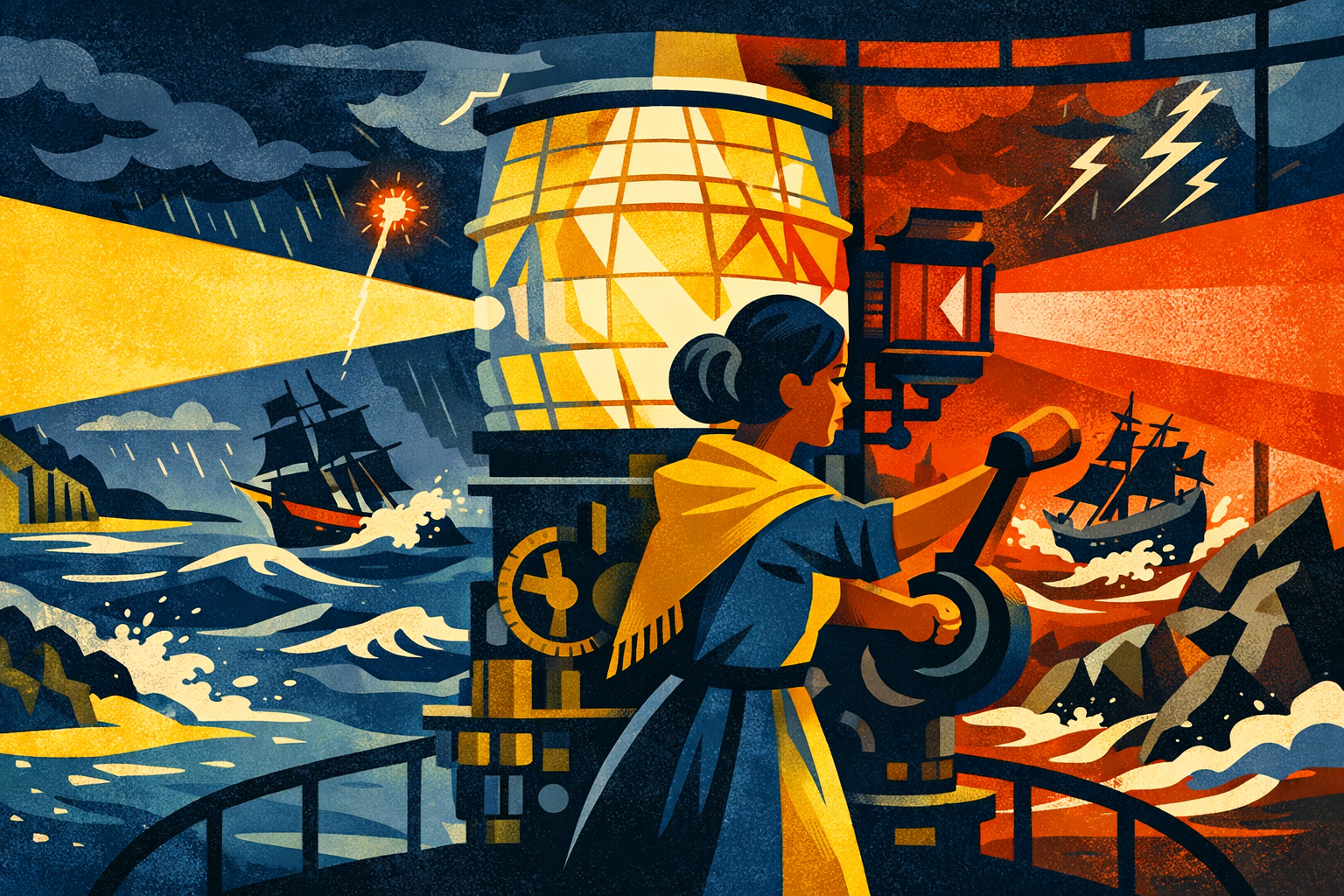
The Lever and the Letter
by StandardSet Curriculum
The storm had teeth. That was how old Silas described it as he watched the barometer drop—a gale that would chew up the coast and spit out driftwood.
Mara stood in the lantern room of the Greystone Lighthouse, seventy feet above the churning Atlantic. The glass walls rattled in their iron frames, assaulted by rain that hit like buckshot. Below her, the ocean was a roiling black void, illuminated only by the rhythmic, blinding sweep of the Fresnel lens.
Flash. Darkness. Flash. Darkness.
Mara was not supposed to be on watch. That was her father’s duty. But Silas was downstairs, gripped by a fever that had burned through him for three days, leaving Mara as the sole guardian of the jagged coastline. She knew the machinery of the lighthouse as well as she knew her own heartbeat. She knew the gears, the oil feeds, and the heavy iron lever that controlled the fog signal.
But tonight, the machinery was the least of her burdens.
Three hours ago, a message had come through the semaphore line from the southern station: The Peregrine is driving north. Rudder damaged. Attempting to make the inlet.
The Peregrine was Kael’s ship.
Kael, who had left Greystone two years ago with a promise pressed into Mara’s palm—a promise to return with enough gold to buy a keel of his own and ask Silas for her hand. For two years, Mara had tended the light, watching the horizon, measuring her life in the rotation of the beam.
But sailors talk, and news travels faster than ships.
Six months ago, a letter had arrived from a cousin in Boston. It spoke of Kael, yes. But it also spoke of the merchant’s daughter who had taken a fancy to the handsome first mate. It spoke of dinners in high parlors, of a father who owned a fleet, and of a wedding planned for the spring. Mara had burned the letter. She had not burned the doubt.
Now, Kael was out there in the dark. The Peregrine was crippled, fighting a sea that wanted to swallow it whole.
Mara gripped the railing. She could see the faint, desperate flare of a ship’s rocket miles out. They were close. Too close to the Razor—a submerged ridge of granite that had claimed a dozen ships in Mara’s lifetime.
There were two channels into the safety of the inlet.
The South Channel was wide and deep, the only safe harbor in a storm this size. If the Peregrine took the South Channel, they would glide into calm waters. Kael would survive. He would step onto the dock, alive and whole. And then, Mara would know. She would see him step off the ship, perhaps with the merchant’s daughter on his arm, or perhaps alone but with his heart already given away. She would have to watch him live a life that didn't include her.
The North Channel was a lie. On a calm day, at high tide, a skilled pilot could thread a small sloop through it. But in a gale like this? It was a gauntlet of foam and stone. A ship the size of the Peregrine would be dashed to pieces within minutes. There would be no survivors.
If Kael took the North Channel, he would belong to the sea. He would never marry the merchant’s daughter. He would remain exactly as he was in Mara’s memory—young, loyal, and hers alone.
The lighthouse had a secondary signal—a red directional lantern used to guide ships when the main beam was obscured by fog.
If Mara swung the red lantern to the left, she signaled the South Channel. She gave him salvation, and she gave him to another woman. If Mara swung the red lantern to the right, she signaled the North Channel. She gave him to the storm, and she kept him forever.
Another rocket flared, closer this time. The ship was blind. They were waiting for her signal. They trusted the Keeper of Greystone to guide them. They didn't know the Keeper was a woman whose heart was a battleground between a two-year-old promise and a six-month-old doubt.
Mara looked at the red lantern. She thought of Kael’s face the day he left, the way the sun caught the salt in his hair. She loved him with a ferocity that frightened her.
Did she love him enough to let him go? Or did she love him too much to let him live?
The wind howled, a sound like a thousand voices screaming in judgment. Mara’s hand closed around the cold iron handle of the lantern mechanism. She could feel the vibration of the storm in the metal.
She didn't hesitate. She didn't tremble. She knew exactly which pain she could endure and which she could not.
She threw the lever.
Questions
Read this sentence from paragraph 1:
The storm had teeth.
How does this personification affect the tone of paragraph 1?
It makes the storm seem controlled and predictable, creating a calm, steady tone.
It makes the storm seem vicious and alive, creating a tense, threatening tone.
It makes the storm seem distant and unimportant, creating a cool, detached tone.
It makes the storm seem exciting and playful, creating a bold, adventurous tone.
Standard: L.9.5
Read this sentence from paragraph 3:
"Flash. Darkness. Flash. Darkness."
How does the author's use of these short, repeated sentences contribute to the tension at the beginning of the passage?
It slows the moment down, giving calm details about the light so the reader feels less anxious about what might happen next at sea.
It matches the quick rhythm of the light, making each flash feel sharper and increasing the reader’s sense that something dangerous could happen at any second.
It provides simple information about the lighthouse, making the reader pay more attention to how the light works than to the threat of the storm around it.
It repeats an ordinary image of the light, making the scene seem routine and causing the reader to expect that nothing unusual or frightening is going to occur.
Standard: RL.9.5
Read this sentence from paragraph 6:
Three hours ago, a message had come through the semaphore line from the southern station: The Peregrine is driving north. Rudder damaged. Attempting to make the inlet.
What does the word semaphore most nearly mean as it is used in this sentence?
a system used to send messages with visual signals over a distance
a system used to measure changes in air pressure during a storm
a system used to record the speed and direction of ocean currents
a system used to guide ships into harbor with fixed stone markers
Standard: RL.9.4
Read this sentence from paragraph 15:
"But in a gale like this? It was a gauntlet of foam and stone."
Based on this sentence, what does the word gauntlet most nearly mean as it is used here?
a narrow, dangerous passage filled with many hidden rocks and obstacles
a calm, open stretch of water with small, gentle rolling waves
a deep, safe channel where ships can travel easily in storms
a sheltered harbor that protects damaged ships from dangerous wind and waves
Standard: L.9.6
In the sentence, "Mara's situation presents a painful paradox: to save Kael's life, she must risk losing him to another, but to keep him as hers alone, she must let him die," what does the word paradox most nearly mean as it is used here?
a situation in which a person faces two choices that both seem impossible to avoid
a situation in which a person discovers a secret that changes everything
a situation in which a person must wait for events to unfold on their own
a situation in which a person misjudges danger and causes great harm
Standard: L.9.4
According to the passage, what does the heavy iron lever in the lighthouse control?
The fog signal used during storms
The main Fresnel lens and its light
The line of semaphore signal flags
The small red directional lantern light
Standard: RL.9.3
Based on how Mara's conflict about which way to swing the red lantern is developed throughout the passage, which statement best expresses a central idea of the text?
The passage suggests that real love sometimes means choosing another person’s safety over one’s own desires.
The passage suggests that dangerous jobs always require people to ignore their personal feelings.
The passage suggests that rumors are more important than the promises people make to each other.
The passage suggests that people who leave home can never return to the relationships they once had.
Standard: RL.9.2
How does the author show Mara’s point of view about which pain she can endure as she decides how to signal the Peregrine?
By describing how carefully Mara understands the gears, oil feeds, and heavy levers of the lighthouse machinery.
By explaining in detail how the North Channel and the South Channel differ in depth, width, and safety.
By revealing Mara’s thoughts as she weighs the pain of losing Kael against the pain of letting him live without her.
By focusing on how fiercely the storm attacks the lighthouse and how dangerous the rocks are below the cliffs.
Standard: RL.9.6
Which sentence from the passage best supports the inference that Mara’s main conflict is choosing between saving Kael’s life and preserving her idealized memory of him?
“If the Peregrine took the South Channel, they would glide into calm waters.”
“If Kael took the North Channel, he would belong to the sea. He would never marry the merchant’s daughter. He would remain exactly as he was in Mara’s memory—young, loyal, and hers alone.”
“She would see him step off the ship, perhaps with the merchant’s daughter on his arm, or perhaps alone but with his heart already given away.”
“She knew the machinery of the lighthouse as well as she knew her own heartbeat.”
Standard: RL.9.1
Read these sentences from the passage:
"Mara had burned the letter. She had not burned the doubt." (paragraph 10)
"She didn't hesitate. She didn't tremble. She knew exactly which pain she could endure and which she could not." (paragraph 23)
Based on details from across the passage, which statement best explains what Mara’s reaction at the lever reveals about her conflicting motivations and how this moment develops a central idea of the story?
It shows she stops trying to escape her hurt and instead chooses the loss she can live with, developing the idea that real love means facing painful truths instead of hiding from them.
It shows she decides her duty as lighthouse keeper is more important than her love for Kael, developing the idea that responsibility to strangers must always outweigh personal feelings.
It shows she realizes the letter about Kael and the merchant’s daughter was false, developing the idea that gossip can be defeated when people fully trust those they love.
It shows she chooses to punish Kael for leaving her and risking the storm, developing the idea that someone who is betrayed in love is right to seek revenge.
Standard: RL.9.3
Generated by StandardSet
standardset.app