The Clockwork Controversy - Grade 7 Informational Reading Assessment
A standards-aligned Grade 7 informational text assessment built around Daylight Saving Time and its real-world impacts on students, safety, and learning. Students read “The Clockwork Controversy” and answer 12 multiple-choice questions that target central idea, text structure, author’s word choice, and evidence-based reasoning. This resource is rigor-focused (including DOK 3 items) and zero-fluff: questions probe misconceptions about DST’s origins (WWI fuel conservation), the author’s argument about modern energy use, circadian rhythm impacts, and the meaning of figurative phrases like “March time heist.” Includes a complete answer key and clear standards tags (RI.7.1–RI.7.6, L.7.4–L.7.6) with StandardSet branding.
The Clockwork Controversy
by Unknown
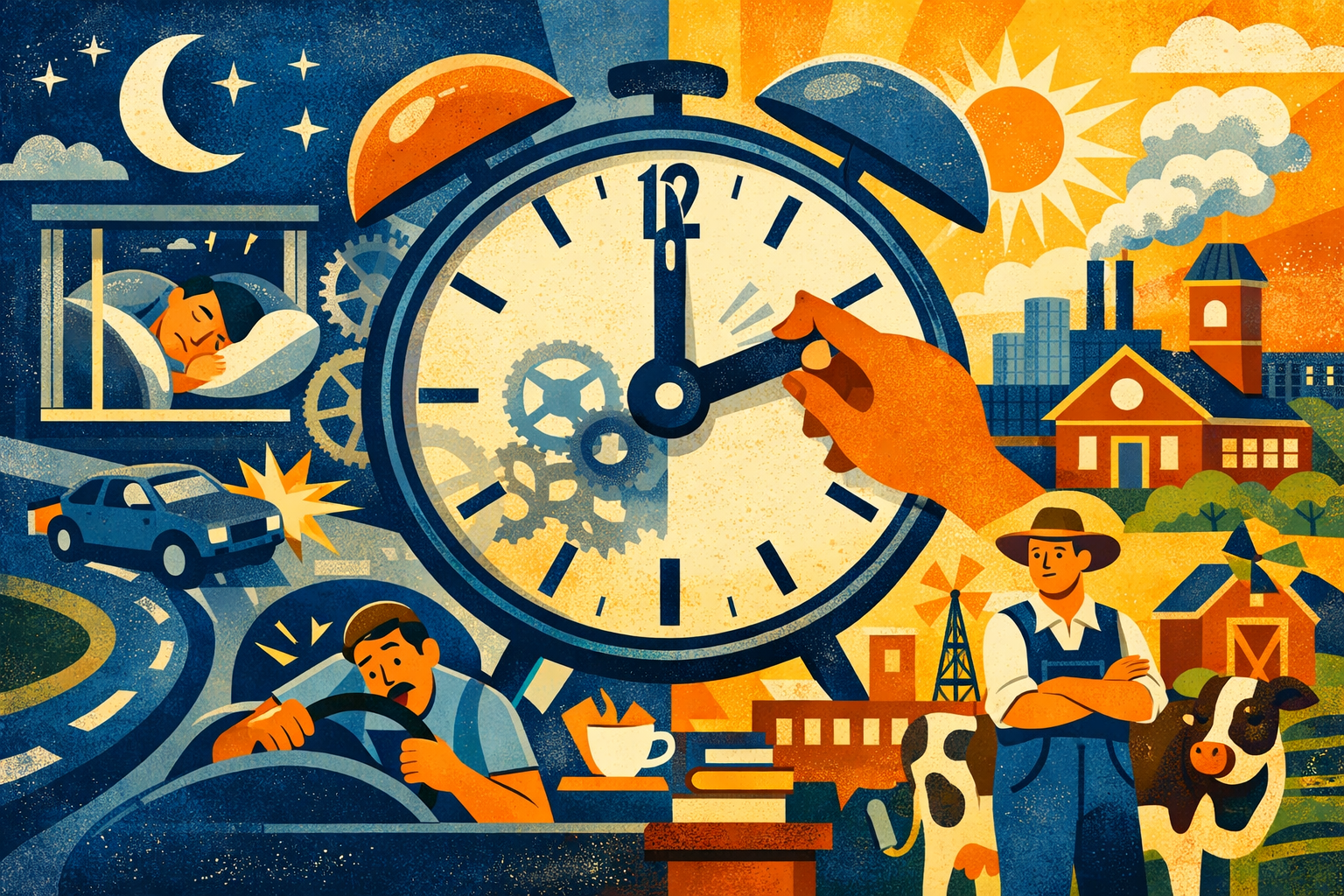
Every year on the second Sunday in March, millions of Americans wake up feeling robbed. The culprit is not a thief sneaking through the window. The thief is the clock. This annual ritual of springing forward marks the beginning of Daylight Saving Time. While losing a single hour of sleep might seem like a minor inconvenience, that missing sixty minutes triggers a massive disruption in schools and workplaces across the country.
A common misconception is that this time shift was created to help agricultural workers. In reality, farmers heavily opposed the idea when it was first introduced. Daylight Saving Time was actually implemented during World War I as a strategy to conserve fuel. By shifting daylight to the evening hours, government officials hoped citizens would rely less on artificial lighting. Today, however, modern energy consumption is driven heavily by air conditioning and electronic devices, making this century-old reasoning seem entirely archaic.
The true cost of this March tradition is biological. The human body operates on a natural twenty-four-hour cycle known as a circadian rhythm. This internal clock is tightly synchronized by the rising and setting of the sun, not by a digital alarm. When society artificially shifts the schedule forward, it forces the brain to demand alertness while the body is still chemically programmed for sleep. This sudden misalignment leads to a documented spike in morning grogginess, increased traffic accidents, and a temporary drop in cognitive performance among students during first-period classes.
Because of these negative impacts, a growing number of citizens advocate for abandoning the practice altogether. Several state legislatures have already passed bills attempting to abolish the biannual clock adjustment. However, locking the clocks permanently requires federal approval. Until a national consensus is reached, the March time heist will remain a mandatory and exhausting tradition.
Questions
Which statement is best supported by details in both paragraph 2 and paragraph 4 of the passage?
that Daylight Saving Time is just as helpful now as when it first started
that the original reasons for Daylight Saving Time are less convincing today
that most workers and farmers strongly support keeping Daylight Saving Time
that the federal government has already agreed to end Daylight Saving Time
Standard: RI.7.1
Which statement best expresses a central idea of the passage The Clockwork Controversy?
Daylight Saving Time causes harmful disruptions to people's lives today, so many citizens think the practice should be ended.
Daylight Saving Time was first created during World War I to save fuel by giving people more evening sunlight.
Daylight Saving Time has always been unpopular with farmers, who believed the time change would interfere with their daily work.
Daylight Saving Time makes many people feel sleepy on the first Monday in March, especially students in early morning classes.
Standard: RI.7.2
How are the biological effects of the March time change connected to the actions of some state legislatures?
The health and safety problems caused by the time change have led some lawmakers to propose ending the clock adjustments.
The health and safety problems caused by the time change have led lawmakers to require more frequent time changes across the country.
The lack of serious health and safety problems from the time change has persuaded lawmakers to keep the current clock system in place.
The lack of serious health and safety problems from the time change has caused lawmakers to ignore any proposals to change the system.
Standard: RI.7.3
Read the excerpts from the passage.
"Every year on the second Sunday in March, millions of Americans wake up feeling robbed. The culprit is not a thief sneaking through the window. The thief is the clock." (paragraph 1)
"Until a national consensus is reached, the March time heist will remain a mandatory and exhausting tradition." (paragraph 4)
Based on these excerpts and the passage as a whole, what does the phrase "the March time heist" most likely mean as it is used in paragraph 4?
the yearly clock change that steals an hour of sleep and energy from people
the yearly war-time plan that saves money and fuel for the government
the yearly calendar event that marks the exciting start of springtime weather
the yearly schedule shift that causes only a brief and harmless confusion
Standard: RI.7.4
How does paragraph 2 mainly contribute to the development of the author's argument in the passage?
It lists current problems in schools and workplaces to show that losing an hour of sleep affects people’s daily lives.
It describes how citizens and state lawmakers are trying to change the law to stop the yearly clock change.
It explains the history and original purpose of Daylight Saving Time to show that its reasons no longer match modern life.
It gives scientific details about the body’s internal clock to prove that changing the time can harm people’s health and safety.
Standard: RI.7.5
Which comparison best explains how the passage shows different interpretations of Daylight Saving Time?
It shows that both the original officials and the author see Daylight Saving Time as helpful, but the officials stress saving fuel and the author stresses modern energy savings.
It shows that the original officials view Daylight Saving Time as a way to help farmers, while the author views it as a tradition that still benefits agricultural workers today.
It shows that the original officials view Daylight Saving Time as a way to save fuel with more evening daylight, while the author views it as an outdated policy that now harms people’s sleep and performance.
It shows that both the original officials and the author see Daylight Saving Time as harmful, but the officials focus on farmers’ problems and the author focuses only on government confusion.
Standard: RI.7.6
Read this sentence from paragraph 2:
"Today, however, modern energy consumption is driven heavily by air conditioning and electronic devices, making this century-old reasoning seem entirely archaic."
Here is a dictionary entry for archaic:
archaic (adjective)
- very old and no longer useful in modern times
- related to the earliest time in history
- used in a particular region or country
- hard to understand because it is very complex
A student infers that archaic means "outdated" in this sentence. Which dictionary definition best supports this inference?
related to the earliest time in history
very old and no longer useful in modern times
used in a particular region or country
hard to understand because it is very complex
Standard: L.7.4
Read this sentence from paragraph 4:
"Until a national consensus is reached, the March time heist will remain a mandatory and exhausting tradition."
What does the word "heist" suggest about how the author views Daylight Saving Time?
It suggests that the author sees Daylight Saving Time as a fun and exciting event people enjoy.
It suggests that the author views Daylight Saving Time as a confusing rule that few people understand.
It suggests that the author believes Daylight Saving Time unfairly takes valuable time away from people.
It suggests that the author considers Daylight Saving Time a serious safety plan created by the government.
Standard: L.7.5
Read this sentence from paragraph 2:
"Today, however, modern energy consumption is driven heavily by air conditioning and electronic devices, making this century-old reasoning seem entirely archaic."
Based on this sentence, what does the word archaic most nearly mean?
very helpful for saving fuel today
very focused on air conditioning use
very important to World War I history
very old and no longer effective today
Standard: L.7.6
How do paragraphs 1 and 3 work together to develop a central idea about Daylight Saving Time in the passage "The Clockwork Controversy"?
Paragraph 1 explains the history of Daylight Saving Time, and paragraph 3 describes how farmers first reacted to the new schedule.
Paragraph 1 introduces the idea that losing an hour causes widespread disruption, and paragraph 3 explains the biological reasons this time change harms people’s alertness and performance.
Paragraph 1 describes how the government creates time-change laws, and paragraph 3 describes how different states protest those laws.
Paragraph 1 shows that people enjoy having more evening sunlight, and paragraph 3 shows that students like staying up later because of the time change.
Standard: RI.7.2
Which conclusion is best supported by information from across the passage?
That Daylight Saving Time continues mainly because it still provides major energy savings for modern society.
That Daylight Saving Time creates only a brief inconvenience and does not seriously affect safety, learning, or health.
That Daylight Saving Time remains in place even though its original purpose is outdated and its harmful effects are becoming more widely recognized.
That Daylight Saving Time is most strongly supported by the people whose work and daily schedules it helps the most, such as farmers and students.
Standard: RI.7.1
Read these sentences from paragraph 2:
"Daylight Saving Time was actually implemented during World War I as a strategy to conserve fuel. By shifting daylight to the evening hours, government officials hoped citizens would rely less on artificial lighting."
The reader determines that conserve means to use something carefully so that it is not wasted. Which phrase from the sentences provides the best evidence for this conclusion?
"implemented during World War I"
"shifting daylight to the evening hours"
"modern energy consumption is driven heavily"
"citizens would rely less on artificial lighting"
Standard: L.7.4
Generated by StandardSet
standardset.app