The King of the Lily Pad (5th Literary)
A humorous-but-rigorous Grade 5 literature assessment built around Barnaby the bullfrog, who thinks he rules the pond—until a Great Blue Heron proves he’s part of a bigger food chain. Students answer 13 multiple-choice questions that go beyond plot recall into theme, vocabulary, figurative language, and narrator’s point of view. Aligned to RL.5.1–RL.5.6 and L.5.6, this StandardSet resource targets evidence-based comprehension (e.g., where the heron stands; how Barnaby solves the problem), interpretation of comparisons ("evaporated like a puddle"), contrast/transition language (the function of "But"), and how structure and POV make Barnaby’s early bragging seem silly by the end. Includes a complete answer key and StandardSet branding with a QR link to generate your own assessments.
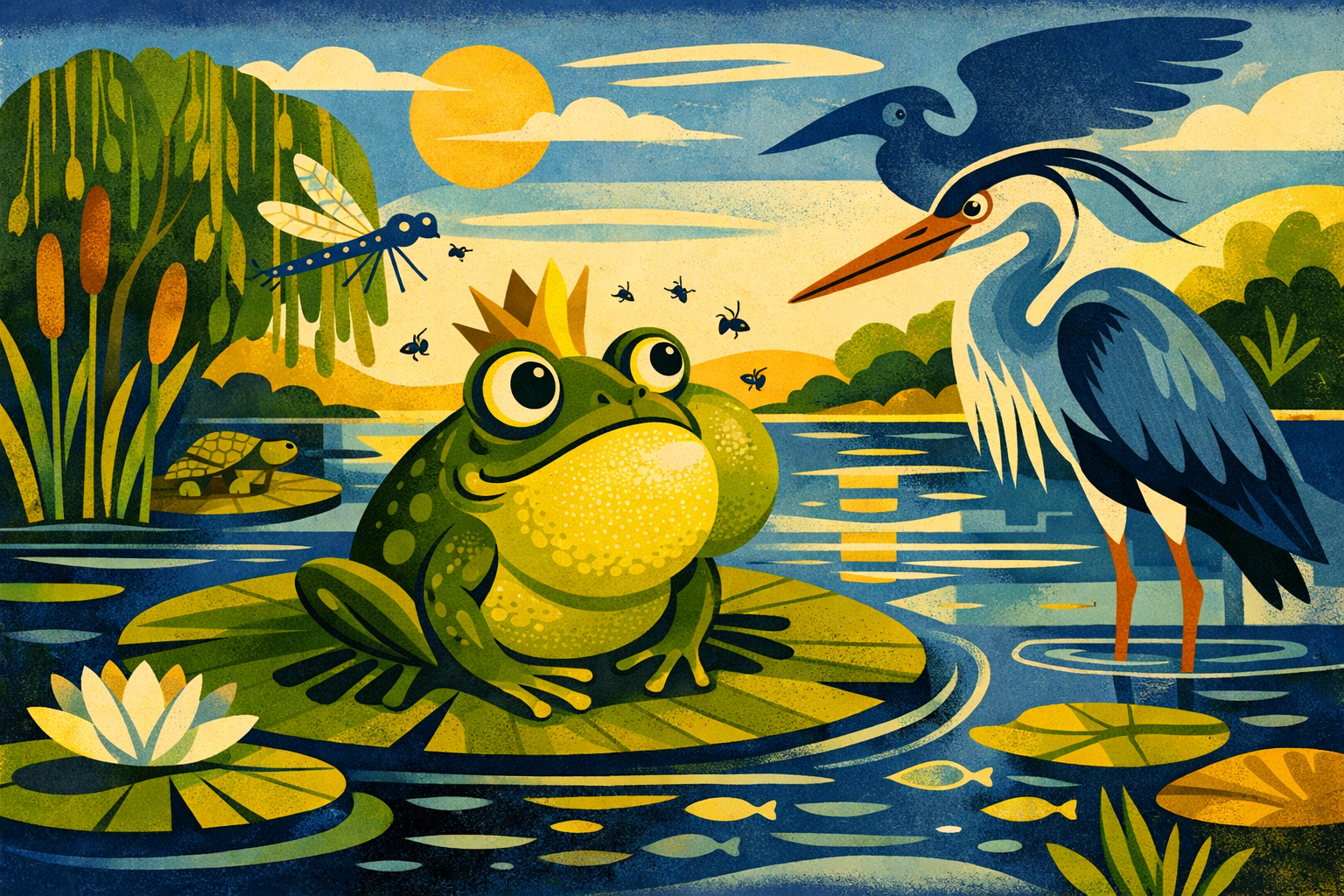
The King of the Lily Pad
by Unknown
Barnaby was not just a bullfrog; in his own mind, he was the Emperor of the Algae, the Sultan of the Swamp, and the King of the Lily Pad. He sat on the largest leaf in the pond, looking like a green balloon that had been inflated one breath too many.
"Ribbit," he croaked deeply. His voice sounded like a rusty cello being played underwater. "Behold my kingdom! I am the top of the heap. The big cheese. The apex!"
Zara, a dragonfly with wings like stained glass windows, buzzed past his nose. She hovered there, her compound eyes shimmering. "Actually, Barnaby," she said, her voice a thin, metallic hum. "You’re really more of a... middle manager. You’re definitely not the boss of the ecosystem."
Barnaby puffed out his throat until he looked ready to pop. "Nonsense! Look at these flies. I snap them up. Zap! Gone. I consume the energy. I am the engine that drives this pond!"
"You’re just a battery, Barnaby," Zara laughed, darting away as Barnaby’s sticky tongue slapped the air where she had been a second ago. "You store the energy from the flies, sure. But you didn’t make it. You’re just borrowing it from the sun."
Barnaby scoffed. The sun? The sun was just a warm spotlight specifically designed to highlight his magnificent, warty skin. He closed his eyes and basked in the heat. The pond was alive around him. The water was a dark mirror, reflecting the willow trees that dipped their long, leafy fingers into the mud. Cattails whispered secrets to one another in the breeze, swaying back and forth like a crowd at a rock concert.
"I fear nothing," Barnaby announced to a passing turtle, who ignored him completely. "I am a rock. Unmovable. Unshakable."
Suddenly, a shadow fell over the lily pad. It wasn't a cloud. It was large, winged, and silent as a ghost.
Barnaby opened one eye. Standing in the shallow water, on legs as thin as pencils, was the Great Blue Heron. The bird stood frozen, a statue made of feathers and patience. Its sharp beak pointed down like a spear.
The "King of the Lily Pad" felt a shiver run down his spine that was colder than the pond mud in January. His bravery evaporated like a puddle on a hot sidewalk.
If I move, Barnaby thought, I am a snack. If I stay, I am dinner.
He realized then that Zara was right. He wasn't the top of the heap. He was just a link in a very long, very dangerous chain. The energy he had bragged about—the flies, the beetles, the moths—was sitting inside him, waiting to be passed on to the heron.
The heron took a slow, deliberate step. Splosh.
Barnaby didn't wait to see the beak strike. With a mighty kick of his powerful back legs, he launched himself off his throne and into the murky safety of the deep water. He swam down, down, down, until he was buried in the soft mud at the bottom, hidden beneath the roots of the very lily pad he used to rule.
Above him, the water rippled. The heron waited a moment, then flew off, its wings beating a slow, heavy rhythm against the sky.
Minutes later, a pair of bulging eyes broke the surface of the water. Barnaby climbed back onto a smaller, humbler leaf.
Zara buzzed back around. "Still the King?" she asked, landing lightly on a reed.
Barnaby let out a small, quiet croak. "Perhaps," he grumbled, "I am just a Prince for today. Being the King is too much work."
Questions
According to the text, where was the Great Blue Heron standing?
On the largest lily pad, like a green balloon in the pond water.
By the dark mirror of the water, near the willow trees and cattails.
In the shallow water, with legs as thin and straight as pencils.
On a willow branch above the dark mirror of the pond.
Standard: RL.5.1
Which event shows how Barnaby solves his main problem with the Great Blue Heron?
He sits on the largest leaf in the pond, feeling very important.
He puffs out his throat and brags to others that he fears nothing.
He scares the heron away by croaking loudly while staying on his lily pad.
He kicks his strong back legs and dives into deep water to hide.
Standard: RL.5.2
Where does Barnaby go to hide when the Great Blue Heron comes near the lily pad?
He swims down to the mud at the bottom, under the lily pad roots.
He hides inside the tall cattails near the edge of the pond.
He jumps behind the willow trees at the edge of the water.
He stays on his big lily pad in the middle of the pond.
Standard: RL.5.3
Read this sentence from paragraph 10:
"His bravery evaporated like a puddle on a hot sidewalk."
What does this comparison show about Barnaby's bravery at that moment?
It shows that Barnaby's bravery was slowly melting away but still partly there.
It shows that Barnaby's bravery was heating up and making him feel stronger.
It shows that Barnaby's bravery was disappearing very quickly and completely inside him.
It shows that Barnaby's bravery was floating gently above him like hot steam.
Standard: RL.5.4
How does the scene with the Great Blue Heron build on the beginning of the story?
It adds more bragging from Barnaby to prove he really is brave.
It shows Barnaby in danger, so he must change his mind.
It introduces new animals that do not connect to Barnaby’s problem.
It explains why the sun and plants are the most important in the pond.
Standard: RL.5.5
How does the narrator's point of view influence how Barnaby's actions seem?
It makes Barnaby sound brave and wise, so the danger seems small.
It shows only Zara's thoughts, so Barnaby always seems unfair.
It makes fun of Barnaby, so his big talk seems silly.
It hides what the heron is doing, so the end is a surprise.
Standard: RL.5.6
Read this sentence from paragraph 5:
"You store the energy from the flies, sure. But you didn’t make it."
What does the word "But" show in this sentence?
It shows that one event happens after another in the story.
It shows the reason why something happens in the sentence.
It shows a difference between two ideas in the sentence.
It shows that two ideas are alike and go together.
Standard: L.5.6
How do Zara and Barnaby respond differently when she questions his claim to be king, and what does this show about them?
Zara stays calm and serious, while Barnaby also stays calm, showing they are both wise and careful.
Zara gets angry and flies away, while Barnaby listens and changes, showing he is open to new ideas.
Zara uses facts to tease Barnaby, while Barnaby brags, showing Zara is wise and Barnaby is proud.
Zara is afraid of Barnaby’s power, while Barnaby is gentle, showing he is kind and she is weak.
Standard: RL.5.3
Read this sentence from paragraph 12:
"He was just a link in a very long, very dangerous chain."
What does the word link mean in this sentence?
a safe place in the pond where he can hide
one part in a chain that joins with other parts
a strong feeling of fear that makes him want to run
a big jump he takes to move from one pad to another
Standard: L.5.6
Which statement best expresses the theme of the story as shown by how Barnaby changes after meeting the Great Blue Heron?
A frog who leaves his big lily pad can escape danger.
Honesty is the best policy, even when it is hard.
Believing you rule everything makes you feel brave but not wise.
Realizing you are not the most important helps you stay humble.
Standard: RL.5.2
Why does Barnaby decide he is 'just a Prince for today' at the end of the story?
Because he wants Zara to believe he has not really changed.
Because he plans to rule a different pond as a stronger king.
Because he thinks the danger in the pond has completely gone away.
Because he now knows he is not in charge and could be eaten.
Standard: RL.5.1
How does the scene in paragraphs 16–18, when Barnaby comes back, change the reader’s understanding of what happened at the beginning of the story?
It only adds extra action and does not connect to the beginning.
It repeats the idea that Barnaby is the strongest in the pond.
It starts a new story by moving Barnaby to a different pond.
It shows Barnaby has changed, so his early bragging now seems silly.
Standard: RL.5.5
Read these sentences from the story:
"Barnaby was not just a bullfrog; in his own mind, he was the Emperor..." (paragraph 1) "The 'King of the Lily Pad' felt a shiver run down his spine..." (paragraph 10)
How does the narrator’s point of view in these sentences influence how the reader understands Barnaby’s place in the pond?
The narrator describes only Barnaby’s bold words to make him seem truly powerful.
The narrator shares Zara’s comments more than Barnaby’s thoughts to show she leads.
The narrator uses only serious details to keep the reader worried about danger.
The narrator shows Barnaby’s proud thoughts and later fear to highlight his small role.
Standard: RL.5.6
Generated by StandardSet
standardset.app