The Invisible Current (5th Informational)
Teach energy flow in ecosystems while building true Grade 5 reading and language rigor. This assessment uses an engaging informational passage on producers, consumers, decomposers, energy pyramids, and food webs—paired with 14 multiple-choice questions aligned to key Common Core standards. Students tackle vocabulary in context (e.g., microscopic, consequently, static), main idea and purpose, text structure, and how examples and comparisons support meaning (RI.5.1-6; L.5.4-6). Includes a complete answer key and StandardSet branding, ready to print or export.
The Invisible Current: Energy Flow in Ecosystems
by StandardSet
Imagine standing in a dense forest, surrounded by towering oaks, scurrying beetles, and the distant call of a hawk. Although these organisms appear distinct, they are bound together by a single, invisible force: energy. Just as a machine requires fuel to operate, every living organism requires energy to sustain life. In the natural world, this energy creates a complex network known as an ecosystem, where the survival of one species is inextricably linked to the survival of another.
The Ultimate Source
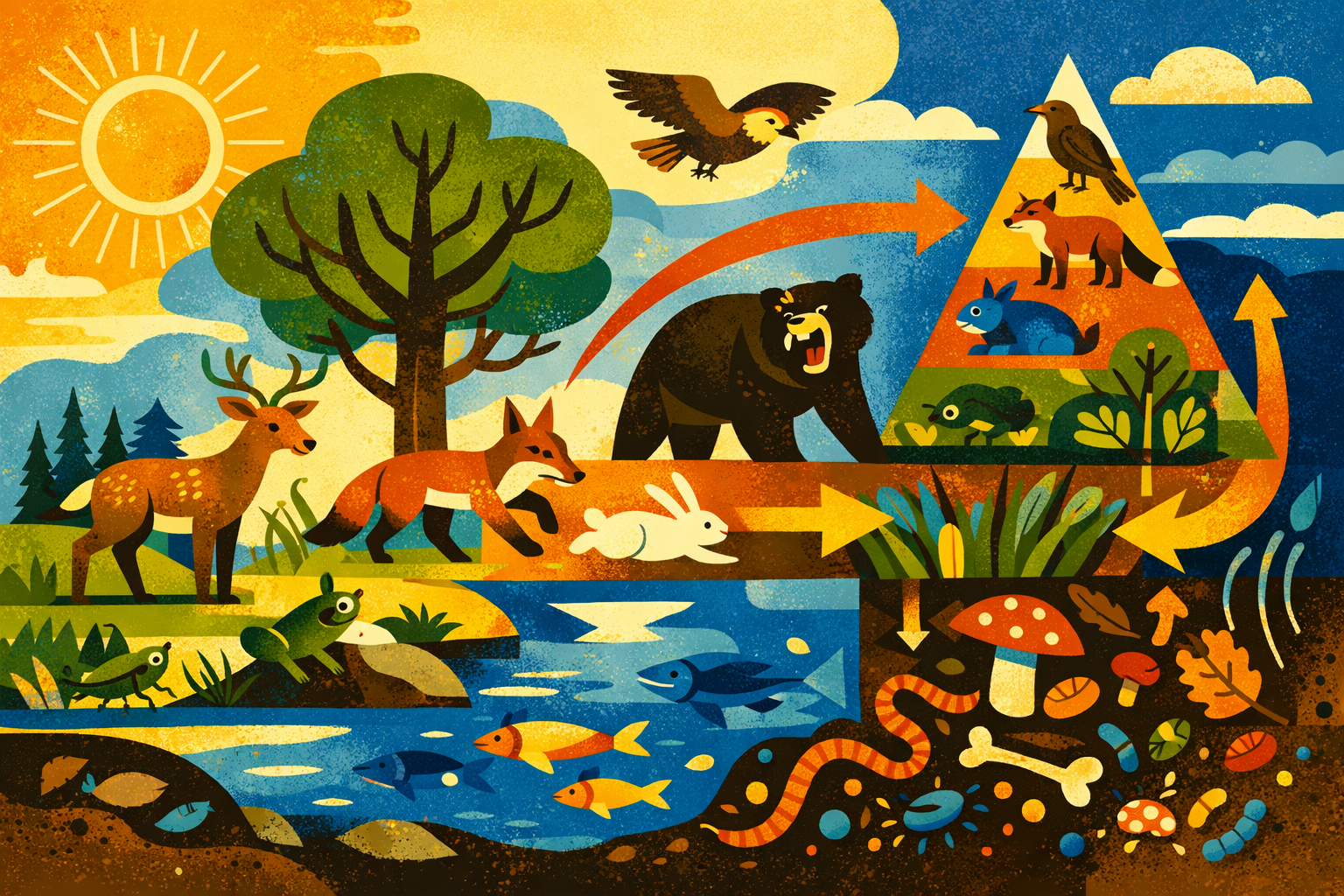
The journey of energy begins 93 million miles away with the sun. It acts as a colossal battery, radiating the power that charges our planet. While animals cannot access this energy directly, plants have evolved to harness it. Through a process called photosynthesis, plants convert solar energy into chemical energy stored within their leaves and stems. Because they produce their own food, scientists classify plants as producers. They serve as the foundation of every ecosystem, from the humid rainforests of the Amazon to the arid deserts of the American Southwest. Without producers, the flow of energy would cease, and life as we know it would vanish.
The Inefficiency of Transfer
Energy does not remain static; it flows. When an organism eats another, energy is passed like a torch in a relay race. Animals that eat plants, such as rabbits or deer, are known as primary consumers. They unlock the chemical energy stored in plant matter to power their own bodies. However, this transfer of energy is highly inefficient.
When a rabbit runs from a predator or maintains its body temperature on a cold night, it burns through the majority of the energy it has consumed. In fact, scientists estimate that only about 10% of the energy at one level of a food chain is successfully transferred to the next. The remaining 90% is lost to the environment as heat or used for the organism's own life processes. Consequently, an ecosystem can support far fewer predators than producers, creating a structure often described as an energy pyramid.
The Web of Interdependence
In a simplified model, a grasshopper eats grass, and a frog eats the grasshopper. However, nature is rarely so linear. Most animals consume a variety of foods to survive; a black bear, for instance, might dine on berries, fish, and insects in a single week. When scientists map these overlapping connections, they create a food web.
This web illustrates a vital concept: interdependence. This means that every species relies on others to maintain balance. If one piece of the biological puzzle is removed, the entire picture shifts. Consider a wetland ecosystem: if a disease were to eliminate the frog population, the insect population might explode uncontrollably, devouring the plant life. Simultaneously, the snakes that rely on frogs for food would face starvation.
The Final Recyclers
The flow of energy eventually reaches the decomposers, a group that includes bacteria, fungi, and worms. Although often overlooked, these organisms perform a critical function in the nutrient cycle. When plants and animals die, decomposers break down the organic matter, returning essential nutrients—such as nitrogen and phosphorus—back to the soil. This process ensures that the soil remains fertile enough for new plants to grow, allowing the cycle of life to begin anew.
By analyzing these relationships, we can see that no creature truly lives in isolation. From the microscopic bacteria in the soil to the apex predator hunting in the valley, we are all caught in the same invisible web, sharing the energy that traveled millions of miles to reach us.
Questions
Read this sentence from paragraph 8:
"From the microscopic bacteria in the soil to the apex predator hunting in the valley, we are all caught in the same invisible web, sharing the energy that traveled millions of miles to reach us."
The root micro means "small." What does microscopic most likely mean in this sentence?
so large that it is hard to fit in the valley
so small that it is hard to see without special tools
so fast that it is hard to watch in the soil
so deep that it is hard to reach in the soil
Standard: L.5.4
Read this sentence from paragraph 4:
"Consequently, an ecosystem can support far fewer predators than producers, creating a structure often described as an energy pyramid." (paragraph 4)
What does the word consequently mean in this sentence?
after that happens
in the same way
because of that
at the start of
Standard: L.5.6
Read this sentence from paragraph 3:
'Energy does not remain static; it flows.'
What does static most nearly mean as it is used in this sentence?
very weak and small, easy to use up fast
very hot and bright, giving off strong light
not moving or changing, staying the same over time
full of life and sound, busy with many things
Standard: RI.5.4
Read this sentence from paragraph 4:
"In fact, scientists estimate that only about 10% of the energy at one level of a food chain is successfully transferred to the next."
According to the passage, how much energy is successfully transferred from one level of a food chain to the next?
About 10% of the energy moves from one level to another.
About 25% of the energy moves from one level to another.
About 50% of the energy moves from one level to another.
About 90% of the energy moves from one level to another.
Standard: RI.5.1
Read this sentence from paragraph 6:
"Consider a wetland ecosystem: if a disease were to eliminate the frog population, the insect population might explode uncontrollably, devouring the plant life."
According to this example, what would happen to the insect population?
It would grow very fast and eat most of the plants there.
It would die out quickly and leave all of the plants unharmed.
It would stay the same size and not change over time.
It would move to dry land and stop living in the wetland.
Standard: RI.5.3
How do decomposers help keep the cycle of life going in an ecosystem?
By putting nutrients back in the soil so new plants can grow.
By eating dead plants so there is more space for new plants.
By giving animals food so they do not need to eat plants.
By taking in energy from the sun and passing it right to animals.
Standard: RI.5.1
Using details from paragraphs 3 and 4, which sentence best summarizes the section The Inefficiency of Transfer?
The section explains that only a small part of energy passes to the next level.
The section explains that energy moves easily between levels, so animals gain most energy.
The section explains that producers make energy from sunlight to support all other living things.
The section explains that predators must eat many prey to avoid running out of food.
Standard: RI.5.2
Which sentence best states a main idea of the whole passage?
Energy from the sun moves through producers, consumers, and decomposers, connecting all living things.
Animals eat many different foods, so scientists draw food webs to show this.
Decomposers in the soil break down dead plants and animals to add nutrients.
Most energy is lost as heat, so very few predators can survive.
Standard: RI.5.2
How does the simile "passed like a torch in a relay race" help explain energy flow in ecosystems?
It shows that energy moves from one organism to another but decreases each time.
It shows that energy moves in a simple circle and always stays the same.
It shows that each animal runs faster so it can catch more energy.
It shows that only the first organism in the chain needs the sun.
Standard: L.5.5
How does the wetland example help explain the relationship between different kinds of living things?
It shows that each animal eats only one kind of food.
It shows that plants can live without animals in the wetland.
It shows that losing one kind of animal changes many other kinds.
It shows that energy moves in only one straight line through nature.
Standard: RI.5.3
How do the sections “The Inefficiency of Transfer” and “The Web of Interdependence” work together to explain energy flow in ecosystems?
“The Inefficiency of Transfer” shows why energy drops at each step, and “The Web of Interdependence” shows how food links depend on that limited energy.
“The Inefficiency of Transfer” explains how plants make energy, and “The Web of Interdependence” shows why plants do not need other living things.
“The Inefficiency of Transfer” lists the levels of the food web, and “The Web of Interdependence” repeats those same levels in a new order.
“The Inefficiency of Transfer” tells what decomposers do with dead things, and “The Web of Interdependence” shows how decomposers keep plants alive.
Standard: RI.5.5
How does the author use different text structures in "The Ultimate Source" and "The Web of Interdependence"?
Both "The Ultimate Source" and "The Web of Interdependence" tell events in time order.
Both "The Ultimate Source" and "The Web of Interdependence" just list facts about energy.
"The Ultimate Source" compares plants and animals; "The Web of Interdependence" compares other animals.
"The Ultimate Source" explains one main idea; "The Web of Interdependence" shows how one change affects many living things.
Standard: RI.5.5
How do the ideas of the energy pyramid and the food web work together to explain balance in an ecosystem?
Both show that because energy is lost, changes in one group spread through many.
Both show that every animal eats the same food to stay in balance.
Both show that the sun gives all groups equal energy in the ecosystem.
Both show that decomposers are the only group that keeps balance.
Standard: RI.5.3
Based on details in the passage, what is the author’s main purpose for writing this text?
to explain how energy moves through ecosystems and why living things depend on each other
to tell an exciting story about one animal’s life in the forest
to describe how scientists travel around the world to study different ecosystems
to persuade readers to stop eating meat so that more animals can live
Standard: RI.5.6
Generated by StandardSet
standardset.app