Raising Mealworms (4th Informational)
A print-ready Grade 4 informational text assessment built around “Raising Mealworms: Science in a Box.” Students read a high-interest science passage about Darkling Beetle metamorphosis and mealworm care, then answer 11 standards-aligned multiple-choice questions. The question set targets vocabulary-in-context (e.g., molting, witness, cycle), main idea and purpose, text structure, and key details—aligned to RI.4.1–RI.4.6 plus L.4.4–L.4.6. Includes a full answer key and StandardSet branding so you can download, assign, and go.
Raising Mealworms: Science in a Box (4th Informational)
by Unknown
If you are looking for a pet that is quiet, easy to feed, and full of surprises, look no further than the mealworm. However, there is a secret about this creature. Despite its name, the mealworm is not actually a worm at all! It is the larva (or baby stage) of an insect called the Darkling Beetle.
Growing mealworms is a fascinating way to watch nature at work. By building a simple habitat, you can witness one of the most amazing changes in the animal kingdom: metamorphosis.
A Lifecycle of Change
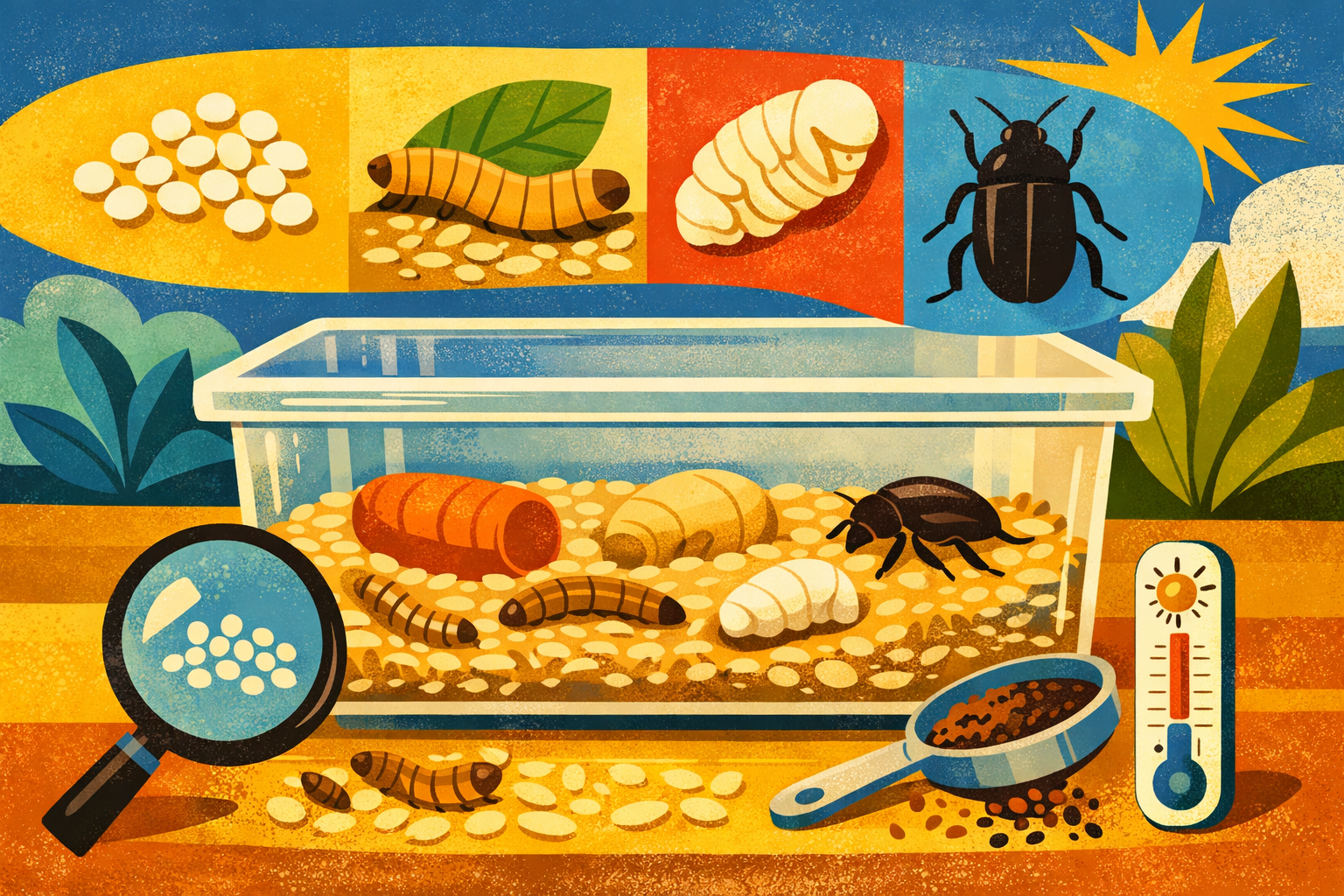
Just like a butterfly, a Darkling Beetle goes through a complete metamorphosis. This means its body changes shape completely as it grows. There are four distinct stages in this lifecycle:
- The Egg: The cycle begins with a tiny white egg. These are about the size of a speck of dust and are very difficult to see without a magnifying glass.
- The Larva (Mealworm): A tiny mealworm hatches from the egg. This is the stage where the insect does most of its eating. As the mealworm eats and grows, its skin becomes too tight. It must shed its hard outer shell to grow larger. This process is called molting. A mealworm will molt more than ten times!
- The Pupa: Once the mealworm is full-grown, it curls up and turns into a white pupa. It looks like a sleeping mummy. It does not eat or move much during this stage, but big changes are happening inside. It is transforming from a crawling larva into a walking beetle.
- The Adult (Beetle): Finally, a Darkling Beetle emerges from the pupa. At first, the beetle is white and soft, but its shell soon turns black and hard. The adult beetle will lay new eggs, and the cycle begins again.
Creating a Mealworm Habitat
You do not need expensive equipment to raise these insects. You can create a healthy habitat, or home, using a plastic container.
| What You Need | Why You Need It |
|---|---|
| Plastic Container | A shoebox or food tub makes a safe home. Keep the lid off or poke air holes so they can breathe. |
| Oatmeal or Bran | Pour 2 inches of oats into the box. This acts as both their bedding and their food. |
| Vegetable Slice | A slice of potato, apple, or carrot provides moisture. This is how mealworms get their water. |
Caring for Your Colony
Taking care of a mealworm colony is simple, but it requires responsibility. You must check on them every few days.
- Watch the Moisture: The most important job is checking the vegetable slice. If it dries out, the mealworms will be thirsty. If it gets moldy, it can make them sick. Replace the slice with a fresh piece once a week.
- Clean the Bedding: As the mealworms eat the oats, they leave behind a dusty waste called frass. Every few weeks, you may need to sift out the frass and add fresh oats to keep their environment clean.
- Temperature: Mealworms prefer a warm, dark place. If the temperature drops too low, their growth will slow down.
Raising mealworms is a front-row seat to science. By observing them closely, you act as a scientist, recording how living things grow, change, and survive!
Questions
Read this sentence from paragraph 9:
"Raising mealworms is a front-row seat to science."
What does the author mean by the phrase "a front-row seat to science" in this sentence?
It means you are feeding the mealworms oats and vegetables so they have enough food to stay healthy.
It means you are building a plastic container habitat so the beetles can have a safe, clean home.
It means you are able to watch the mealworms very closely as they grow, change, and become beetles.
It means you are keeping the mealworms in a warm, dark place where almost no light can reach.
Standard: L.4.5
Read these sentences from paragraph 4:
As the mealworm eats and grows, its skin becomes too tight. It must shed its hard outer shell to grow larger. This process is called molting.
What does the word molting mean as it is used in these sentences?
taking off its outer shell
finding its first egg
growing into a beetle
resting in its bedding
Standard: L.4.6
Based on the passage, why would mealworms be a good animal for students to study in science class?
Because they make noise and move a lot, so it is easy for students to notice them.
Because they need many different foods and tools, so students can practice using lots of equipment.
Because they are simple to care for and let students clearly watch how an insect’s body changes.
Because they must stay in the dark and grow slowly, so students do not have to check them often.
Standard: RI.4.1
What is the main idea of the entire passage?
Raising mealworms is hard work because you must keep their habitat very clean all the time.
Raising mealworms is an easy way to watch their life cycle and learn how they grow and change.
Darkling beetles begin life as tiny eggs that turn into mealworms and then pupas as they develop.
Mealworms need a plastic box, oats, and vegetable slices so they can live safely in your home.
Standard: RI.4.2
How does replacing the vegetable slice once a week help the mealworms in their habitat?
It keeps their home dark so they will stay calm, quiet, and hidden.
It adds more oats so they will have extra bedding and food to use.
It keeps their water fresh and stops mold that could make them sick.
It helps them eat more so they can molt and grow more quickly.
Standard: RI.4.3
Read this sentence from paragraph 2:
By building a simple habitat, you can witness one of the most amazing changes in the animal kingdom: metamorphosis.
What does the word witness most nearly mean as it is used in this sentence?
to read facts about mealworms in a book
to see the mealworms change with your own eyes
to keep the mealworms from changing at all
to guess how the mealworms might change later
Standard: RI.4.4
What does the word cycle mean as it is used in paragraph 4?
a series of stages that happen again and again
a two-wheeled vehicle people ride for fun
a tiny white egg that is hard to see
a special tool that helps people study animals
Standard: L.4.4
How does the author organize the information in the section "A Lifecycle of Change" to help the reader understand the mealworm’s life cycle?
by listing each stage in time order and explaining what happens during that stage
by comparing mealworms to other insects to show how they are alike and different
by describing problems mealworms face and giving ways to solve those problems
by explaining how different causes, like temperature, lead to changes in the insects
Standard: RI.4.5
Based on the passage, which statement best explains why raising mealworms helps students learn about how living things survive?
It lets students see how mealworms eat oats and vegetables to get food and water, and it shows how their waste must be cleaned out to keep them healthy.
It lets students see how mealworms start as tiny eggs, and it teaches that these eggs are very hard to see without a magnifying glass.
It lets students see that mealworms like a warm, dark place, and it shows that they will grow more slowly if the temperature gets too low.
It lets students see that mealworms are quiet and easy to feed, and it proves that they make better pets than many other animals.
Standard: RI.4.1
How do the sections “A Lifecycle of Change” and “Caring for Your Colony” work together to support the main idea of the passage?
“A Lifecycle of Change” explains how mealworms grow, and “Caring for Your Colony” tells how to care for them so you can observe each stage.
“A Lifecycle of Change” lists the supplies you need, and “Caring for Your Colony” explains why each supply is important.
“A Lifecycle of Change” describes why mealworms need water, and “Caring for Your Colony” shows different ways to give them water.
“A Lifecycle of Change” tells where mealworms live in the wild, and “Caring for Your Colony” compares the wild to a habitat in a box.
Standard: RI.4.2
Based on the details about the mealworm life cycle and how to care for them, what is the author's main purpose for writing this passage?
to describe what mealworms and Darkling Beetles look like at each life stage
to explain how to raise mealworms and observe their complete life cycle
to compare the mealworm life cycle to the life cycle of butterflies
to convince readers that mealworms are the best pets for home science
Standard: RI.4.6
Generated by StandardSet
standardset.app