Romance vs. Rust (10th Informational)
A high-interest Grade 10 Valentine's Day informational text assessment on the “love lock” trend—how a romantic public ritual turned into a structural and environmental crisis for historic bridges like Paris’s Pont des Arts. Students answer 13 multiple-choice questions that move beyond recall into central idea, author’s purpose, text structure, and word choice. Built to target Common Core RI.10.1–RI.10.6 and L.10.4–L.10.6, this StandardSet resource includes DOK-aligned analysis prompts (including simile/tone, “architectural vandalism,” “stewardship,” and “check” in context) plus a complete answer key. Perfect for test prep, independent practice, or a standards-based quiz you can print and use immediately.
Romance vs. Rust (10th/Informational)
by Unknown
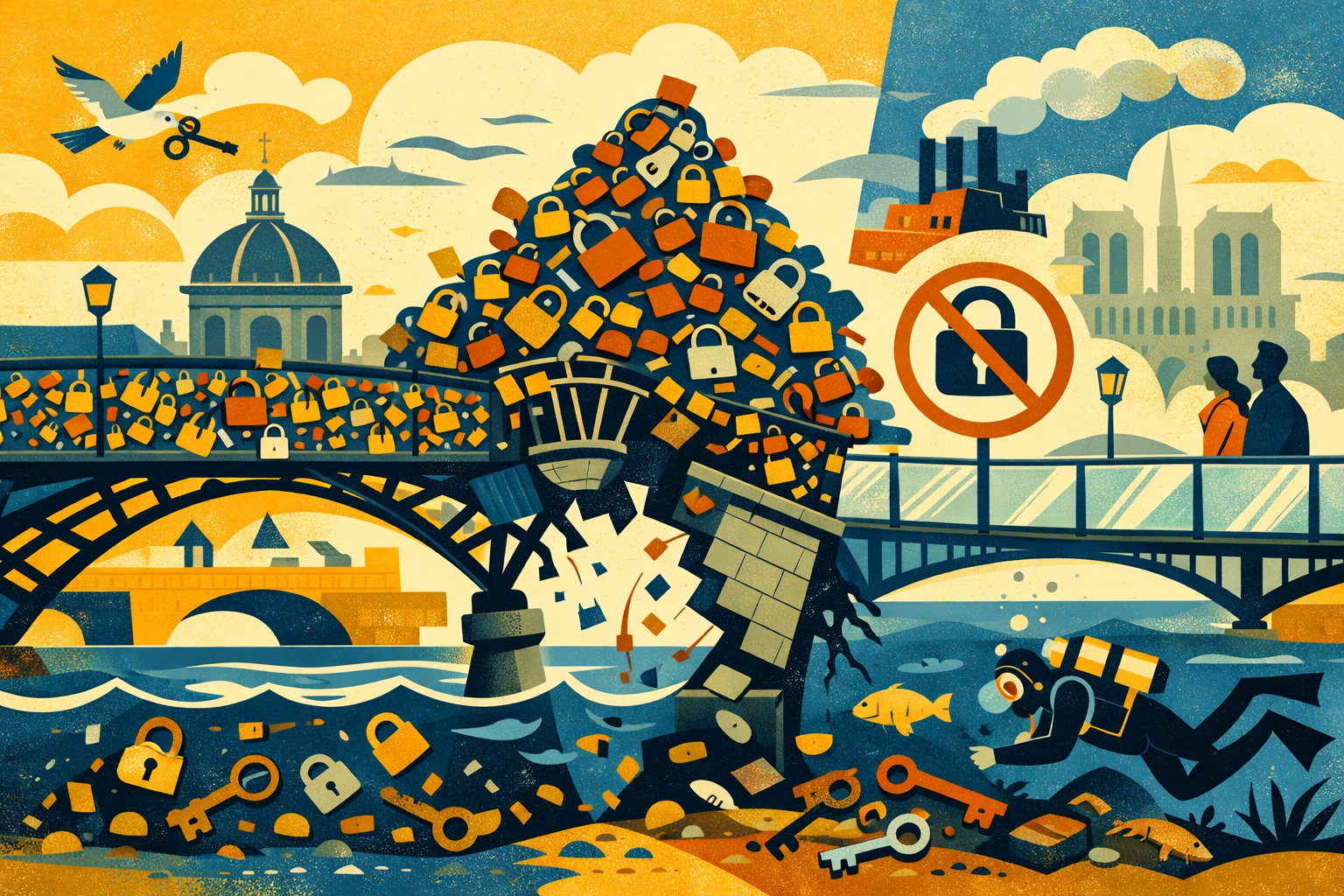
To the casual observer crossing the Pont des Arts in Paris a decade ago, the railing appeared to be a shimmering, chaotic mosaic of brass and steel. Upon closer inspection, however, this metallic tapestry revealed itself to be thousands of padlocks, each inscribed with initials, dates, or declarations of eternal devotion. The ritual is simple and undeniably romantic: a couple fastens a lock to a public bridge and tosses the key into the river below, symbolically sealing their bond forever. Yet, this modern gesture of individual sentiment has collided violently with the realities of civic stewardship. What begins as a harmless token of love, when multiplied by millions, becomes an act of architectural vandalism that forces cities to choose between preserving emotional expression and protecting their physical infrastructure.
While the "love lock" craze exploded globally in the age of social media, its roots are surprisingly somber and localized. The tradition traces back to Vrnjačka Banja, a small spa town in Serbia, shortly before World War I. According to local lore, a schoolmistress named Nada died of heartbreak after her fiancé, a soldier named Relja, abandoned her for another woman while serving overseas. Terrified of suffering a similar fate, young women in the town began fastening padlocks to the Most Ljubavi (Bridge of Love) where Nada and Relja once met, believing the charm would bind their own partners to them. For nearly a century, this remained a quiet, superstitious custom known only to the region.
The transformation of this obscure ritual into a global infrastructure crisis was catalyzed by pop culture. The release of Federico Moccia’s 2006 novel I Want You (Ho voglia di te), and its subsequent film adaptation, featured a scene where the protagonists attach a lock to a lamppost on Rome’s Milvio Bridge. The imagery resonated powerfully with a young, global audience. Almost overnight, the practice migrated from fiction to reality. From the Brooklyn Bridge in New York to the Hohenzollern Bridge in Cologne, historic structures began groaning under the sudden, unplanned accumulation of steel.
The conflict between romance and preservation reached its breaking point in Paris. The Pont des Arts, a delicate pedestrian bridge constructed in the early 1800s, was designed to support the weight of strolling couples, not a heavy industrial load. By 2014, city engineers estimated that the accumulated locks weighed a staggering 45 tons—roughly equivalent to a herd of elephants standing on the bridge’s mesh panels. Physics eventually won out over sentiment; in June of that year, a section of the parapet collapsed under the strain. Though no injuries occurred, the incident served as a stark wake-up call: the collective weight of affection was literally dismantling the city’s heritage.
Beyond the structural dangers, the ritual posed a silent threat to environmental stewardship. The second half of the tradition—tossing the key into the water—created an ecological hazard hidden beneath the surface. In the Seine and the Tiber, divers discovered tens of thousands of rusting iron keys settling on the riverbeds. As the metal corrodes, it leaches heavy metals into the water, disrupting aquatic ecosystems and threatening water quality. Lisa Anselmo, co-founder of the advocacy group No Love Locks, framed the issue not as a war on romance, but as a defense of history. "It is not a gesture of love to deface a public landmark," she argued. "We are stewards of these cities, and we have a duty to pass them on to the next generation intact."
Faced with compromised engineering and polluted waterways, municipalities launched counter-offensives. Paris officials permanently removed the locks from the Pont des Arts in 2015, replacing the wire mesh with glare-proof plexiglass panels that offered no purchase for a padlock. The solution was effective, if clinically unromantic. Other cities followed suit, implementing fines and launching "Love Without Locks" campaigns that encouraged couples to take selfies rather than leave physical traces.
The rise and fall of the love lock trend offers a compelling case study in the tragedy of the commons. A single lock is negligible; a million locks are catastrophic. The phenomenon forces a reevaluation of how we interact with public spaces in the modern era. While the impulse to leave a permanent mark on the world is human, true stewardship requires the maturity to recognize that some things are more valuable than our own personal narratives. Ultimately, the most enduring way to honor a historic landmark is to leave it exactly as it was found, ensuring that it stands strong enough to carry the weight of future generations.
Questions
In which city did engineers estimate that the locks on the Pont des Arts weighed about 45 tons by 2014?
Rome
New York
Paris
Cologne
Standard: RI.10.1
Based on paragraph 2, which statement best expresses the central idea of this paragraph?
The paragraph explains that the love lock tradition began as a local superstition in a Serbian town, inspired by a tragic romance and remaining mostly unknown outside the region for nearly a century.
The paragraph explains that the love lock tradition protected young women from heartbreak by magically binding their partners to them forever, giving couples confidence that their relationships would survive distance and time.
The paragraph explains that the love lock tradition was created during World War I because soldiers often abandoned their fiancées while serving overseas, so women needed a new way to secure their relationships.
The paragraph explains that the love lock tradition became globally popular after people heard the heartbreaking story of Nada and Relja, causing tourists everywhere to copy the ritual on bridges in their own cities.
Standard: RI.10.2
How does the author connect the original love lock tradition described in paragraph 2 to the later environmental and structural problems described in paragraphs 4 and 5?
By showing how a small, local superstition, once popularized, leads to large-scale damage to bridges and rivers.
By explaining how pollution in European rivers long ago led young women to invent the love lock superstition.
By arguing that the original Serbian custom was already causing the same serious harm to bridges and waterways.
By suggesting that city officials now use environmental fears about locks and keys to discourage modern romance.
Standard: RI.10.3
Read this sentence from paragraph 1:
"What begins as a harmless token of love, when multiplied by millions, becomes an act of architectural vandalism that forces cities to choose between preserving emotional expression and protecting their physical infrastructure."
What does the phrase "architectural vandalism" most nearly mean as it is used in this sentence?
artistic decoration added to public bridges and buildings to make them more personal
careless design of public bridges and buildings that ignores safety and structure limits
harmful damage to public bridges and buildings caused by people’s selfish romantic acts
planned changes to public bridges and buildings decided by city leaders and officials
Standard: RI.10.4
How does paragraph 7 function within the structure of the passage?
It explains the tragic love story that first inspired people to attach locks to a bridge.
It describes the physical and environmental damage caused when too many locks are added to bridges.
It broadens the discussion by linking the love lock trend to a wider idea about using shared public spaces responsibly.
It details the specific steps city officials took to remove the locks and to discourage the practice in the future.
Standard: RI.10.5
Based on the passage, what is the author mainly trying to do?
to celebrate the romantic history of love locks and support keeping them on bridges
to show that love locks, though romantic, create serious problems for cities and the environment
to describe how social media and popular culture helped spread the love lock custom worldwide
to persuade tourists to visit famous bridges so they can take part in the love lock tradition
Standard: RI.10.6
Read the excerpt from paragraph 6 and the sentence that follows:
"Other cities followed suit, implementing fines and launching 'Love Without Locks' campaigns that encouraged couples to take selfies rather than leave physical traces." (paragraph 6)
A journalist later summarized these actions by writing, "City leaders hoped these measures would check the spread of love locks before more bridges were damaged."
Here is a dictionary entry for the verb check:
check (verb)
- to stop or slow the progress of something, especially to prevent harm
- to look at something quickly in order to find information or mistakes
- to leave personal items in a place where they will be kept safely
Based on the excerpt and the dictionary entry, which definition best fits the way check is used in the sentence?
to stop or slow the growth of something harmful
to look over something quickly in order to find mistakes
to leave personal belongings in a place for safekeeping
to record information by putting a small mark on a list
Standard: L.10.4
Read this sentence from paragraph 4:
"By 2014, city engineers estimated that the accumulated locks weighed a staggering 45 tons—roughly equivalent to a herd of elephants standing on the bridge’s mesh panels."
How does the author's use of this simile affect the tone of the paragraph?
by making the situation seem playful and harmless through a humorous animal image.
by suggesting the bridge is impressively strong and can easily support a huge weight.
by linking the locks to nature and tradition, giving the practice a gentle, nostalgic feel.
by emphasizing the extreme, unnatural weight of the locks and highlighting their serious danger.
Standard: L.10.5
Read this sentence from paragraph 5:
"Beyond the structural dangers, the ritual posed a silent threat to environmental stewardship."
Based on this sentence and the passage as a whole, what does the word stewardship most nearly mean?
careful management and protection
complete power and control
strict rules and punishment
public attention and praise
Standard: L.10.6
Based on the passage, what conclusion can be drawn about the author's view of public romantic gestures like love locks?
They are harmless displays of affection that cities should never try to regulate.
They are a serious threat to historic bridges and should be banned without exception.
They are emotionally attractive traditions that must be limited when they harm public spaces.
They are old-fashioned customs that most modern couples no longer find meaningful.
Standard: RI.10.1
How does the author develop the connection between the origins of the love lock tradition in paragraphs 2–3 and the civic responses described in paragraphs 4–6 to deepen the central idea about public stewardship?
By describing the somber Serbian legend and then the joyful Parisian scene, in order to argue that the love lock custom, despite its risks, should be preserved as an important romantic tradition.
By explaining how social media rapidly spread the custom worldwide and left city officials unable to keep up, in order to suggest that long-term efforts to protect public spaces are unrealistic in a digital age.
By following the custom from a local superstition to a pop-culture craze and then to structural and environmental crises that lead to new policies, in order to show how private gestures can create public duties.
By comparing community responses in early twentieth-century Serbia and modern European capitals, in order to claim that governments have always exaggerated the dangers of youthful expressions of love in public places.
Standard: RI.10.3
Based on paragraphs 1, 4, and 7, how does the author develop the central idea that individual romantic gestures can create serious problems for shared public spaces?
By using paragraph 1 to praise the charm of the locks, paragraph 4 to describe how cities tried to protect tourism, and paragraph 7 to argue that romance should always outweigh practical concerns.
By using paragraph 1 to warn about environmental damage, paragraph 4 to focus on the economic cost to governments, and paragraph 7 to conclude that stricter laws are the only real solution.
By using paragraph 1 to introduce the tension between private sentiment and public responsibility, paragraph 4 to provide concrete evidence of physical harm, and paragraph 7 to broaden this conflict into a general lesson about shared resources.
By using paragraph 1 to tell the origin story of the locks, paragraph 4 to emphasize public anger at the trend, and paragraph 7 to summarize the city campaigns that successfully ended the practice.
Standard: RI.10.2
How do the author's rhetorical choices throughout the passage most effectively support his point of view about the "love lock" trend?
by celebrating the emotional power of the tradition through vivid stories of couples and by downplaying practical concerns about bridges and rivers, the author encourages readers to protect the ritual as an essential form of modern romance.
by focusing mainly on the Serbian legend and repeating sentimental language from that story, the author suggests that the historical roots of the practice are more important than its present effects on cities and the environment.
by contrasting romantic descriptions of the locks with stark accounts of structural and environmental damage and by including specific statistics and activist quotations, the author convinces readers that the custom harms the cities it claims to honor.
by presenting city officials’ responses in a neutral, procedural tone and by avoiding emotionally charged language about love or damage, the author leaves it to readers to decide whether the practice should continue.
Standard: RI.10.6
Generated by StandardSet
standardset.app